
Three States of Mind: Why You React the Way You Do (and How to Come Back to Yourself)
Have you ever reacted to something in a relationship and later thought:
“Why did I respond like that?”
Maybe you became overwhelmed quickly.
Maybe you shut down.
Maybe you said something you didn’t fully mean.
Or maybe you felt emotionally flooded and couldn’t think clearly in the moment.
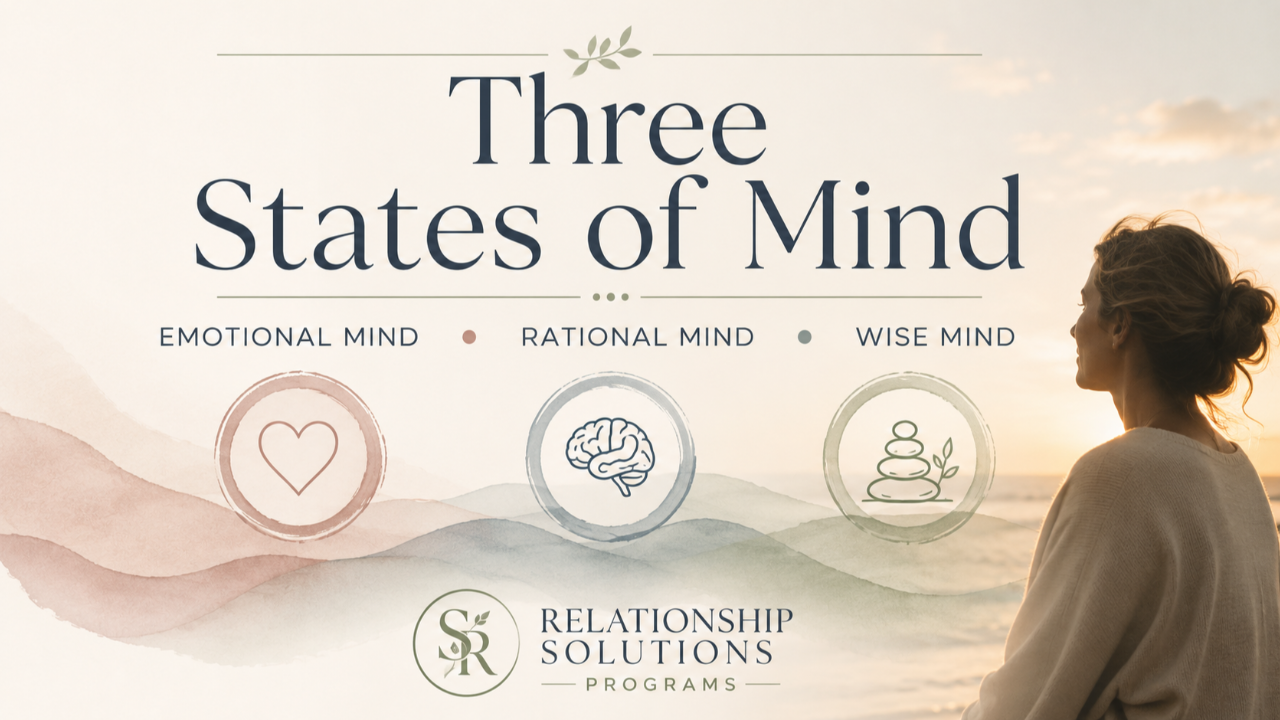
One of the most helpful concepts I use with clients is understanding that we don’t always operate from the same “state of mind.”
And when you begin to recognize which state you’re in, your reactions start making a lot more sense.
Especially in relationships.
Because most people don’t suddenly become irrational, reactive, or emotionally distant out of nowhere.
They’ve simply shifted into a different internal state.
Understanding these three states of mind can help you develop greater emotional awareness, improve communication in relationships, and respond more thoughtfully during conflict.
1. Emotional Mind
Emotional mind is the state where feelings are leading.
It’s fast.
Intense.
Urgent.
And in the moment, it often feels completely convincing.
The internal dialogue sounds something like:
“If I feel this strongly, it must be true.”
When you’re operating from emotional mind, you may notice:
-
reacting quickly
-
feeling emotionally flooded
-
taking things personally
-
struggling to pause before responding
-
saying things you later regret
But emotional mind is not bad.
This is where empathy lives.
Connection.
Passion.
Care.
Vulnerability.
You need access to this part of yourself in order to feel deeply connected to others.
The challenge is that when emotions become unregulated or triggered, they can completely hijack perspective.
This is often what happens during relationship conflict.
A small moment suddenly feels enormous because the nervous system interprets it as emotional danger.
And from there, people tend to react instead of reflect.
2. Rational Mind
Rational mind lives on the opposite end of the spectrum.
This state is governed by logic, analysis, and problem-solving.
The thinking here sounds like:
“Let’s just think about this clearly.”
“What actually makes sense?”
“What’s the most practical solution?”
Rational mind helps people:
-
stay organized
-
make decisions
-
create structure
-
solve problems
-
move toward goals
This state is incredibly useful.
But when someone relies too heavily on rational mind, they can disconnect from emotion entirely.
And in relationships, that can feel painful.
This is often when a person comes across as:
-
emotionally unavailable
-
dismissive
-
detached
-
overly intellectualized
While rational mind can keep things efficient, it doesn’t always keep things emotionally connected.
And relationships require both.
3. Wise Mind
Wise mind is the integration of emotional mind and rational mind.
It’s the grounded middle space where emotion and logic can coexist.
Not perfection.
Not emotional suppression.
Not overanalyzing.
Integration.
Wise mind sounds like:
“I can feel this deeply… and still think clearly.”
This state allows you to:
-
respond instead of react
-
stay connected without abandoning yourself
-
hold boundaries calmly
-
communicate more effectively
-
see the bigger picture during conflict
Wise mind is often quieter than the other two states.
It doesn’t scream.
It doesn’t panic.
It doesn’t shut down.
It pauses.
And that pause is powerful.
Because in relationships, the pause between feeling and reacting can completely change the direction of a conversation.
What This Looks Like in Real Life
Imagine you’re in a difficult conversation with your partner.
Something gets said, and you immediately feel hurt.
Emotional mind says:
“That’s not okay. Say something right now.”
Rational mind says:
“Don’t react. Just ignore it and move on.”
Wise mind says:
“That hurt. Let me slow down for a second and decide how I actually want to respond.”
That moment of awareness creates choice.
And choice changes relationships.
Why Understanding These States Matters
Many people move through relationships without realizing which internal state is driving their behavior.
But awareness changes everything.
When you begin noticing your patterns, you stop assuming every emotion is an emergency.
You also stop dismissing your emotions entirely.
Instead, you learn how to hold both emotion and clarity at the same time.
That’s emotional maturity.
And it’s one of the most important skills for healthy relationships.
Therapeutic Takeaway
You are not supposed to live in wise mind all the time.
That’s not realistic.
We all move in and out of emotional mind and rational mind throughout the day.
The goal is not perfection.
The goal is awareness.
To gently ask yourself:
-
What state am I in right now?
-
What’s driving my reaction?
-
What would help me come back to center?
Even small moments of self-awareness can interrupt unhealthy relationship patterns and create more grounded communication.
Final Thought
The goal isn’t to eliminate emotion.
And it’s not to become purely logical either.
The goal is integration.
To stay connected to your feelings without becoming consumed by them.
To think clearly without disconnecting from yourself or others.
Because when you can hold both emotion and reason together, you become much harder to pull off course by conflict, stress, or emotional triggers.
And that changes not only how you communicate—
but how you experience relationships altogether.
If you’re interested in learning more about emotional awareness, relationship dynamics, and personal growth within relationships, explore more resources at relationshipsolutionsprograms.com.
#relationships #relationshipadvice #emotionalawareness #wisemind #emotionalregulation #relationshipgrowth #communicationskills #mentalwellness #selfawareness #relationshippsychology #attachmentstyles #healthyrelationships

Stay connected with news and updates!
Disclaimer
The views, opinions, and content expressed and produced by our guests do not necessarily reflect the views, opinions, or policies of Relationship Solutions Programs or Susan Regan. If you have any questions, concerns, or feedback regarding content, please contact Susan Regan.