
What Actually Drives Us: The 6 Core Needs Underneath Our Behavior
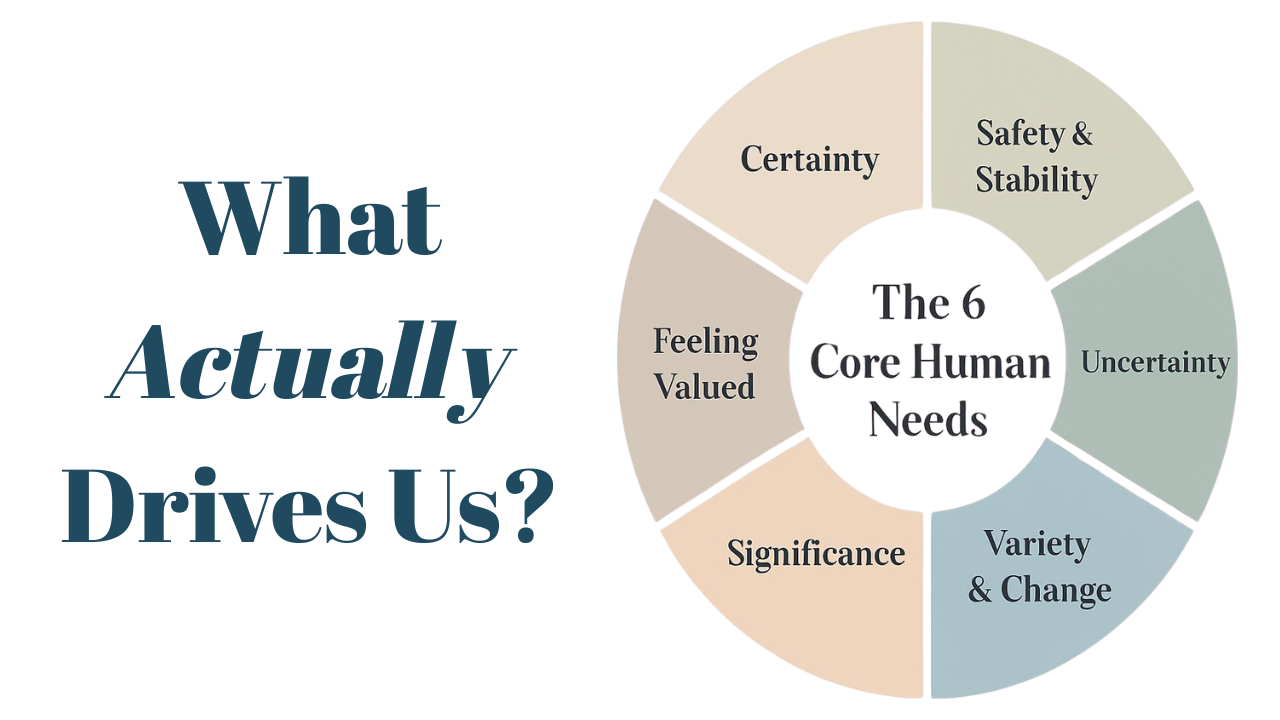
A lot of what I see in my work comes down to this:
People think they’re arguing about content—
but they’re actually reacting to unmet needs underneath the surface.
When you understand these needs, people start to make a lot more sense.
Including yourself.
These six core human needs show up in every relationship, every conflict, and every decision.
1. Certainty — The Need to Feel Safe and Secure
At the most basic level, we all need some sense of stability.
We want to know:
- What’s happening
- What to expect
- That we’re going to be okay
Certainty looks like structure, plans, and reliability.
But here’s where it gets tricky—
when we don’t feel certainty, we often try to force control.
That’s when you see:
- Overplanning
- Rigidity
- Needing things to go a very specific way
It’s not control for the sake of control.
It’s the nervous system trying to feel safe.
2. Uncertainty — The Need for Variety and Aliveness
At the same time, we don’t want life to feel flat or predictable.
We need novelty, spontaneity, and surprise.
This is where energy, creativity, and curiosity come from.
But too much uncertainty can feel destabilizing.
So we’re constantly balancing these two:
- Enough certainty to feel grounded
- Enough uncertainty to feel alive
When couples struggle here, one is usually leaning toward safety,
while the other is leaning toward freedom.
And they start to see each other as the problem.
3. Significance — The Need to Feel Seen and Valued
This one shows up everywhere.
We all want to feel like we matter.
Like we’re not interchangeable.
Significance can look like:
- Being respected
- Being acknowledged
- Feeling unique or valued
But when this need isn’t met, it can come out sideways:
- Defensiveness
- Needing to be right
- Escalating conflict just to be heard
Underneath all of that is usually something much simpler:
“Do I matter to you?”
4. Love & Connection — The Need to Feel Close
This is the one people tend to name the most.
We want closeness.
We want to feel understood, cared for, and emotionally connected.
But here’s what I see all the time:
People want connection—but they’re not always able to create it in the moment.
When someone is triggered, overwhelmed, or shut down,
their capacity for connection drops.
And then both people feel alone at the same time.
This is why I talk so much about emotional regulation.
Because without some level of grounding,
it’s very hard to actually experience connection—even if you want it.
5. Growth — The Need to Evolve and Expand
We don’t just want things to stay the same.
There’s a part of us that wants to expand, learn, and become something more.
Growth can look like:
- Self-awareness
- Taking risks
- Doing something differently than you’ve done before
But growth is uncomfortable.
It asks you to step out of what’s familiar.
And sometimes that creates tension in relationships—
especially if one person is growing faster or in a different direction.
6. Contribution — The Need for Meaning and Impact
At a certain point, it’s not just about you anymore.
There’s a deeper need to:
- Give
- Support
- Make a difference
This might show up in your work, your family, or your community.
When this need is met, people often feel a deeper sense of meaning.
When it’s not, life can start to feel flat—or self-focused in a way that doesn’t feel good.
How These 6 Needs Shape Relationships
Here’s the part I want people to really understand:
These needs don’t go away.
They’re always operating—whether you’re aware of them or not.
So when there’s conflict, instead of asking:
“What’s wrong with you?”
A better question is:
“Which need is not being met right now?”
Because most reactions make sense
when you understand what’s underneath them.
Final Thought: Awareness Creates Change
You don’t need to eliminate these needs.
You need to understand how you try to meet them—
and whether the way you’re meeting them is actually working.
When you start to track that,
in yourself and in the people you care about—
There’s more compassion.
Less personalization.
And a lot more clarity about what’s actually going on.

Stay connected with news and updates!
Disclaimer
The views, opinions, and content expressed and produced by our guests do not necessarily reflect the views, opinions, or policies of Relationship Solutions Programs or Susan Regan. If you have any questions, concerns, or feedback regarding content, please contact Susan Regan.