
Chapters of Development: Why Your Life Keeps Changing (Even When You Didn’t Plan It To)
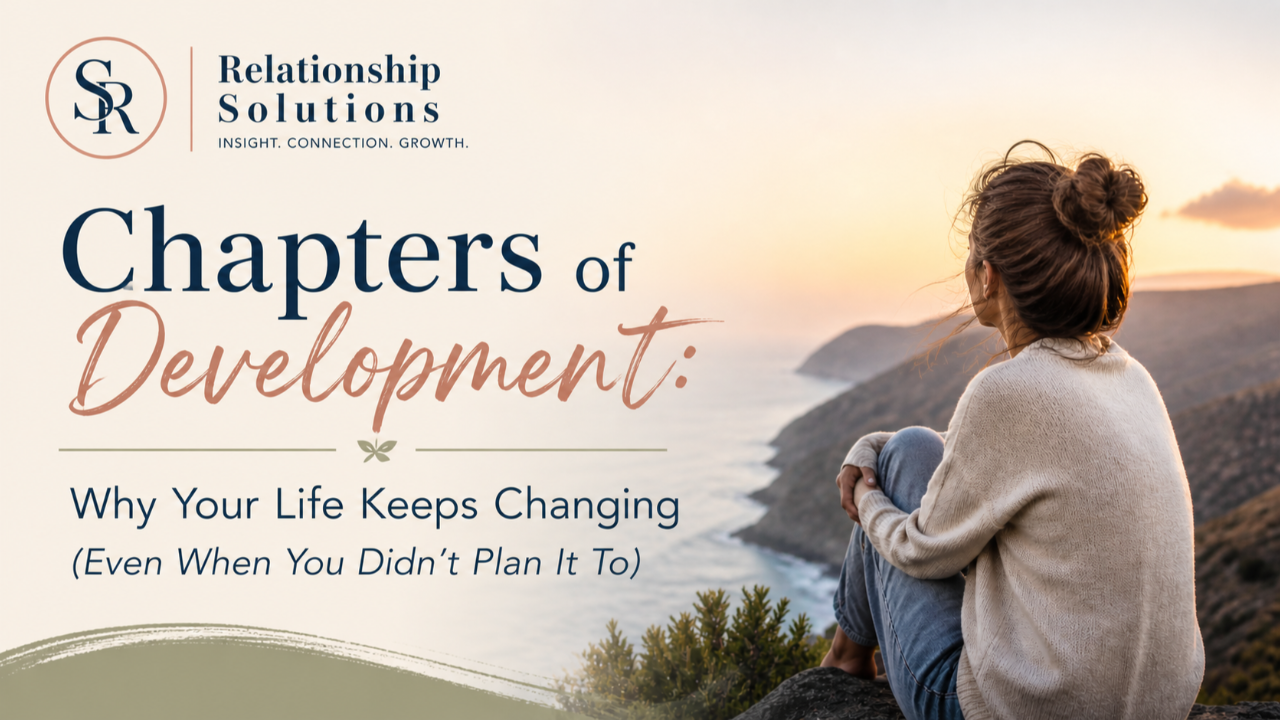
There’s a moment that many people experience, but don’t always have language for.
You build a life that feels like it works. Your routines start to settle. Your relationships feel familiar. There’s a sense of stability, maybe even a quiet confidence that you’ve figured something out.
And then, something begins to shift.
It’s not always dramatic. Sometimes it’s subtle at first. A feeling you can’t quite name. A kind of restlessness that shows up in small moments. Conversations that used to feel easy now feel a little off. Things that once excited you don’t land the same way anymore.
You might try to ignore it at first. Or push through it. Or tell yourself you should just be grateful for what you have.
But the feeling tends to linger.
And eventually, it raises a deeper question:
Why doesn’t my life feel the way it used to?
It’s easy, in moments like this, to assume something has gone wrong. That you made a mistake. That you chose the wrong path, the wrong relationship, the wrong version of your life.
But often, that’s not what’s happening.
What you’re experiencing may not be a problem to fix.
It may be a transition.
Growth Doesn’t Happen All at Once
One of the more challenging truths about being human is that we don’t arrive at a fixed version of ourselves.
There isn’t a point where you figure everything out and then simply maintain it.
Instead, development happens in chapters.
And each chapter reorganizes what matters to you.
This is part of what makes growth both meaningful and, at times, disorienting. Because the very things that once helped you build your life may not be the things that help you continue growing within it.
Who you were five or ten years ago made sense for that stage of your life. The choices you made, the relationships you formed, the goals you pursued—those were aligned with what you needed at that time.
But people evolve.
And as you evolve, your internal world begins to shift. Your emotional needs change. Your priorities deepen or rearrange. Your tolerance for certain dynamics expands in some ways and narrows in others.
This is where the tension begins.
Because your external life doesn’t always change at the same pace as your internal one.
So you can find yourself living in a structure that once fit you well, while quietly feeling that it no longer reflects who you are becoming.
When What Worked Stops Working
This is often the moment people struggle with the most.
Because it feels contradictory.
If something worked before—if it helped you feel stable, connected, or successful—why wouldn’t it keep working?
But growth doesn’t operate that way.
What worked wasn’t wrong. It was right for a previous version of you.
And as that version shifts, the strategies, roles, and dynamics attached to it can begin to feel limiting rather than supportive.
This shows up in different ways for different people.
Sometimes it’s in relationships. A dynamic that once felt comfortable starts to feel constraining. You may notice yourself reacting differently, wanting something more, or feeling less able to ignore things you once tolerated.
Sometimes it’s in your work or daily structure. What once felt motivating begins to feel repetitive or draining. There’s a sense that something is missing, even if everything looks fine from the outside.
And sometimes it’s more internal than external. You may feel disconnected from parts of yourself. Less certain. More reflective. More aware of patterns you didn’t notice before.
None of this necessarily means you need to immediately change everything in your life.
But it does mean something in you is changing.
And that deserves attention.
The In-Between Space
There’s a phase in development that people often try to avoid.
It’s the space where the old version of your life no longer fully fits, but the new version hasn’t fully formed.
This space can feel deeply uncomfortable.
It can feel like restlessness without direction. Like questioning without answers. Like standing in a place where clarity hasn’t arrived yet, but certainty has already left.
You may notice yourself second-guessing things that once felt clear. You may feel more emotional, or more distant, or more sensitive to dynamics that previously didn’t affect you as much.
It can be tempting to interpret this as instability.
But in many ways, it’s actually a sign of development.
Because something is reorganizing beneath the surface.
Your mind is making sense of new awareness. Your emotional system is recalibrating. Your sense of identity is expanding beyond what it used to be.
This doesn’t happen instantly.
And it doesn’t happen without discomfort.
But that discomfort isn’t meaningless.
It’s part of the process of becoming more aligned with yourself.
Your Inner Signals Begin to Change
One of the quieter but more powerful indicators that you’re moving into a new chapter is a shift in what resonates with you.
You might find yourself drawn to different kinds of conversations. Topics that once felt abstract now feel deeply relevant. You may crave more depth, more honesty, more emotional presence in your interactions.
At the same time, certain dynamics may begin to feel more difficult to engage with. You might notice a lower tolerance for surface-level communication or for patterns that once felt manageable.
This can create a sense of distance, even in relationships that have been important to you.
And that can feel confusing.
Because it’s not always about the other person changing.
Sometimes, it’s about you seeing things more clearly than you did before.
Your interests may shift as well. Creative outlets, ways of spending time, even the environments you feel comfortable in may begin to change.
It’s not uncommon for people to resist this.
To try to hold onto who they’ve always been. To stay consistent with an identity that once felt solid.
But these internal shifts are not random.
They’re informative.
They’re often guiding you toward a version of your life that feels more aligned with who you are now.
Letting Go Isn’t Always Obvious
When people think about growth, they often focus on what they’re gaining.
New insight. New direction. New opportunities.
But growth also involves loss.
Not always in a dramatic or visible way. Sometimes it’s subtle. Quiet.
It’s the gradual release of identities you’ve outgrown. The realization that certain roles no longer feel authentic. The awareness that some dynamics don’t support who you’re becoming.
This can be one of the more emotionally complex parts of development.
Because those identities and roles were once meaningful. They may have helped you feel connected, valued, or understood.
So letting go of them isn’t just about change.
It’s about acknowledging that something that once fit you no longer does.
And that can bring up a mix of emotions.
Grief. Uncertainty. Even guilt.
Especially if the people or structures around you haven’t changed in the same way.
But holding onto something solely because it used to fit can quietly keep you from stepping into what actually does.
Relationships and Changing Chapters
One of the places where developmental shifts become most visible is in relationships.
Because relationships are built on patterns.
Ways of communicating. Ways of responding. Roles that each person plays, often without fully realizing it.
As you grow, your awareness of these patterns tends to deepen.
You may begin to notice dynamics that you didn’t see before. You may feel more affected by certain interactions. Or you may find yourself wanting something different—more openness, more emotional safety, more mutual understanding.
This doesn’t mean the relationship is failing.
But it does mean the relationship may need to evolve.
And that can require conversations that feel unfamiliar. It can require both people to become more aware of their patterns and more willing to adjust them.
Not every relationship shifts at the same pace.
And not every relationship is able to adapt.
But recognizing these changes is an important part of understanding your own development.
Because relationships often mirror where you are in your growth.
You’re Not Meant to Feel Certain All the Time
There’s an expectation many people carry, often without realizing it, that once they reach a certain point in life, things should feel stable in a permanent way.
That clarity should last.
That certainty should hold.
But development doesn’t work like that.
Life moves in phases. And each phase introduces new questions.
So periods of uncertainty are not a sign that you’re doing something wrong.
They’re often a sign that you’re engaging with something more deeply than you have before.
This doesn’t mean you need to act on every feeling or make immediate changes.
But it does mean it’s worth paying attention.
Because awareness is what allows change to happen in a meaningful, intentional way.
A Different Kind of Question
When life starts to feel like it’s shifting, the instinct is often to try to return to what felt stable.
To recreate what used to work.
To find your way back to a version of your life that made sense.
But growth rarely asks you to go backward.
It asks you to become more aware.
So instead of asking, “How do I get back to where I was?”
A different question might be more useful.
What is this chapter asking of me?
Not in a pressured or urgent way.
But in a curious one.
Because that question creates space.
It allows you to notice what’s changing without immediately trying to fix it. It helps you stay connected to yourself while things are still forming.
And over time, that awareness tends to lead somewhere more aligned than simply trying to return to what once was.
Gentle Reflection
If you find yourself in a place where things feel unsettled or unclear, you’re not alone in that experience.
Many people move through these phases quietly, without realizing that what they’re feeling is part of a larger developmental process.
You might take a moment to reflect:
What feels like it no longer fits in your life right now?
And what feels like it might be asking for your attention, even if you don’t fully understand it yet?
If you’re exploring changes in your relationships or within yourself, you can find more insights, courses, and resources at relationshipsolutionsprograms.com
#personalgrowth #lifetransitions #selfawareness #emotionalgrowth #relationshippatterns #innerwork #personaldevelopment #relationshiphealth #mindfulliving #growthjourney

Stay connected with news and updates!
Disclaimer
The views, opinions, and content expressed and produced by our guests do not necessarily reflect the views, opinions, or policies of Relationship Solutions Programs or Susan Regan. If you have any questions, concerns, or feedback regarding content, please contact Susan Regan.