
Boundaries in Relationships: What They Really Are (and Why They Matter More Than You Think)
Introduction: Where Boundaries Quietly Break Down in Relationships
There’s a moment in many relationships where something small starts to feel bigger than it should. Plans change, a tone shifts, or a request lands in a way that doesn’t sit quite right. Underneath it, there’s often a quieter awareness—something here doesn’t feel good, but it’s hard to name exactly why.
Most people move past these moments. They tell themselves it’s not a big deal or that they don’t want to overreact. They adjust, accommodate, and keep things moving. On the surface, everything appears fine. But internally, something begins to build—a subtle tension, a quiet resentment, or a growing sense of disconnection from themselves.
This is often where boundaries are missing. Not in the obvious or dramatic moments, but in the subtle places where we override what we feel in order to maintain connection.
What Are Boundaries in Relationships? A Clear and Practical Definition
Boundaries are one of the most talked about—and most misunderstood—parts of relationships. They are often framed as rigid, distancing, or even selfish. Many people worry that setting boundaries will push others away or create unnecessary conflict.
In reality, boundaries are what make relationships sustainable.
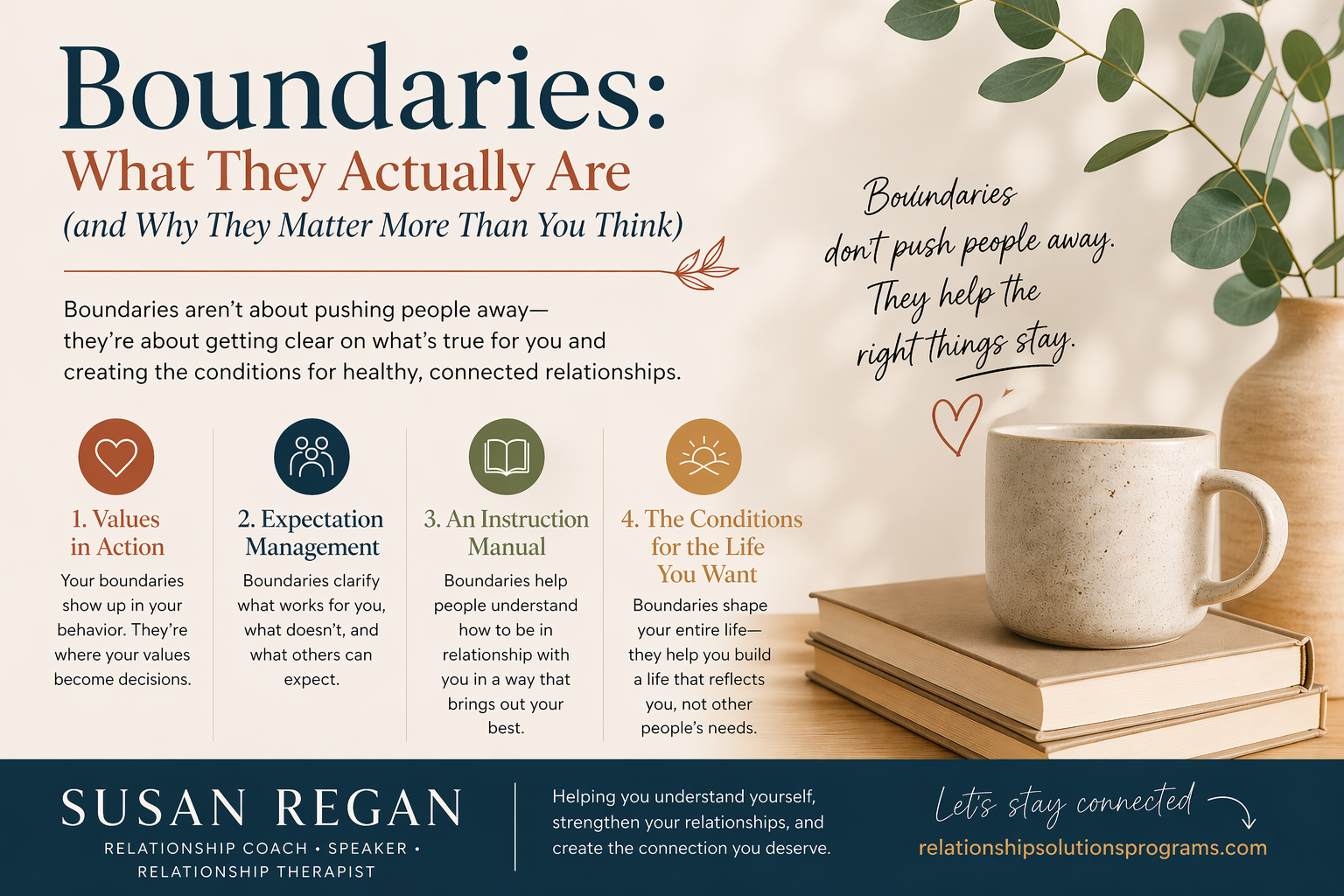
They are not about controlling someone else’s behavior. Instead, boundaries are about getting clear on what is true for you and allowing your choices and actions to reflect that clarity. When boundaries are present, relationships tend to feel more stable, communication becomes more direct, and connection feels more genuine.
At their core, boundaries are a form of self-definition within relationship. They allow you to stay connected to yourself while also being connected to someone else. Without them, it becomes much easier to lose your sense of alignment in the process of maintaining closeness.
Why Setting Boundaries Feels So Difficult for Many People
If boundaries are so essential, why do they feel so uncomfortable to set?
For many people, boundaries are tied to deeper emotional fears. There can be a fear of disappointing someone, being misunderstood, creating tension, or even losing the relationship altogether. Because of this, adapting often feels safer than expressing what is actually true.
You might notice yourself saying yes when you mean no, staying quiet when something feels off, or minimizing your own needs to keep things smooth. These responses are not random—they are often learned patterns that developed in earlier relationships where connection may have felt uncertain or conditional.
In some cases, people learn that being easygoing, accommodating, or low-maintenance helps preserve connection. Over time, this can create a habit of prioritizing others’ comfort over internal clarity.
For example, someone might agree to plans they don’t have the energy for because they don’t want to disappoint a partner or friend. In the moment, it keeps things easy. But over time, those small moments of self-abandonment can create frustration and emotional distance.
Understanding this pattern is important, because it reframes boundaries as more than just a communication skill. They are part of learning how to stay connected to yourself, even when there is a risk of discomfort in the relationship.
Boundaries Are Values in Action
One of the clearest ways to understand boundaries is to see them as values in action.
It’s easy to identify what you value—rest, respect, honesty, time, or emotional safety. But those values only become meaningful when they are reflected in your behavior. If you say you value rest but consistently overextend yourself, your life won’t reflect that value. If you say you value respect but allow interactions that feel dismissive or hurtful, that value is not being upheld.
Boundaries are the point where your internal priorities become visible externally.
They often show up in small, everyday decisions. Choosing not to respond immediately when you need time to think. Letting someone know when something didn’t sit well. Deciding not to engage in a conversation that feels unproductive or emotionally draining.
For instance, if you value calm and emotional steadiness, a boundary might look like stepping away from a heated conversation rather than staying in it out of obligation. If you value reliability, it might look like being honest about what you can realistically commit to instead of overpromising.
These are not dramatic gestures. They are consistent, grounded choices that keep your behavior aligned with what matters most to you.
How Boundaries Improve Communication and Reduce Conflict
Many relationship conflicts are not the result of harmful intent. More often, they come from unclear or unspoken expectations.
When expectations are not defined, people naturally fill in the gaps. They tend to do this based on their own experiences, needs, and assumptions. This is where misunderstandings begin.
For example, one person may view frequent texting as a sign of care and connection, while another may experience constant communication as overwhelming. Without a conversation about it, both individuals may feel frustrated or misunderstood.
Boundaries help reduce this kind of friction by creating clarity. They communicate what works for you, what doesn’t, and what others can expect from you. They also help you become clearer about what you expect from yourself in the relationship.
When expectations are expressed openly, there is less room for misinterpretation. Instead of reacting to assumptions, people are responding to something that has been clearly communicated.
This kind of clarity is not harsh—it is stabilizing. It allows both people to engage with a shared understanding rather than navigating uncertainty.
Boundaries as a Way to Show Others How to Be in Relationship With You
Boundaries can also be understood as a way of showing others how to experience the best version of you.
People don’t automatically encounter your most present, grounded, or engaged self. They experience that version of you when the conditions support it. When you are consistently overextended, overwhelmed, or saying yes when you mean no, your ability to show up fully becomes limited.
In those moments, you might notice yourself becoming less patient, less attentive, or quietly resentful. Not because you don’t care, but because your internal capacity has been stretched.
Boundaries help protect that capacity.
They communicate what you need in order to stay present and connected. This might look like asking for time before responding, being honest about your availability, or adjusting plans so you can show up more intentionally.
For example, instead of agreeing to a last-minute plan when you feel depleted, a boundary might sound like acknowledging that you want to spend time together but need to reschedule in order to be more present. This kind of response protects both your energy and the quality of the interaction.
In this way, boundaries are not about creating distance. They are about supporting a more meaningful and sustainable connection.
How Healthy Boundaries Shape the Life and Relationships You Want
Boundaries are not just about isolated moments within relationships—they shape the overall structure of your life.
Every decision to engage, step back, speak up, or stay silent contributes to the environment you are creating. Over time, these choices accumulate and influence how your life feels on a daily basis.
If you want more peace, you will need boundaries around chaos, overcommitment, or constant availability. If you want to feel respected, you will need boundaries around what you are willing to tolerate in conversations and interactions. If you want deeper and more consistent connection, you will need boundaries around inconsistency or emotional unavailability.
For example, someone who values consistency in relationships may need to acknowledge when a dynamic feels unpredictable or one-sided, rather than continuing to invest in it without clarity.
Without boundaries, it is easy to build a life that revolves around other people’s needs and expectations. While this may keep relationships functioning on the surface, it often leads to a gradual sense of disconnection from yourself.
With boundaries, your life begins to reflect your values more clearly. Your relationships become more aligned, and your energy is directed toward what feels meaningful rather than what feels obligatory.
What Boundaries Are Not: Common Misconceptions
Understanding what boundaries are not is just as important as understanding what they are.
Boundaries are not about controlling someone else’s behavior or forcing them to change. They are not about punishing people, shutting them out, or avoiding difficult conversations. They are also not rigid rules that leave no room for flexibility.
Healthy boundaries are grounded in awareness rather than reactivity. They tend to sound less like demands and more like clear expressions of what works for you.
There is a meaningful difference between saying, “You need to stop doing that,” and saying, “That doesn’t work for me.” One attempts to control the other person, while the other communicates personal truth.
This distinction is what allows boundaries to support connection rather than undermine it.
Examples of Healthy Boundaries in Everyday Relationships
In practice, boundaries are often simple and direct. They are not always perfectly expressed, and they don’t need to be.
They might look like taking time before committing to something, expressing when something didn’t feel right, or acknowledging a need for space. They can also involve choosing not to engage in conversations or situations that feel misaligned.
For instance, you might let a partner know that you need a little time to process before continuing a conversation, or you might be honest about not having the capacity to take something on right now.
These moments may seem small, but they play an important role. They allow you to remain connected to yourself while also staying in relationship with someone else.
Over time, these small expressions of clarity create a stronger foundation for trust, understanding, and connection.
Conclusion: How Boundaries Support Healthier, More Authentic Relationships
Boundaries can feel uncomfortable at first, especially if you are used to adapting, accommodating, or prioritizing harmony. There can be a strong pull to return to familiar patterns of smoothing things over or staying quiet.
But as boundaries become more integrated, something begins to shift.
You start to feel more grounded and more aligned with yourself. Your relationships become clearer, with less confusion and less unspoken tension. There is a greater sense of stability because expectations are more visible and understood.
Over time, you may also notice a deeper sense of self-trust. Not because every interaction becomes easy, but because you are responding to situations in a way that reflects what is true for you.
And that changes the quality of your relationships.
Boundaries do not push people away. They create the conditions for relationships that are more honest, more grounded, and more sustainable.
They don’t reduce connection—they support the kind of connection that can actually last.
Reflection
What is one small moment in your current relationships where something doesn’t quite feel right?
And what might change if you responded to that moment with a little more clarity about what is true for you?
If you’re noticing yourself in some of these patterns, that awareness matters.
Small moments of clarity—like the ones we’ve talked about here—are often where real change begins.
If you’d like more support in understanding your relationship patterns and building healthier connections, you can learn more at:
relationshipsolutionsprograms.com

Stay connected with news and updates!
Disclaimer
The views, opinions, and content expressed and produced by our guests do not necessarily reflect the views, opinions, or policies of Relationship Solutions Programs or Susan Regan. If you have any questions, concerns, or feedback regarding content, please contact Susan Regan.