
More Time Together Isn’t Always More Connection: What Summer Stress Can Reveal About Your Relationship
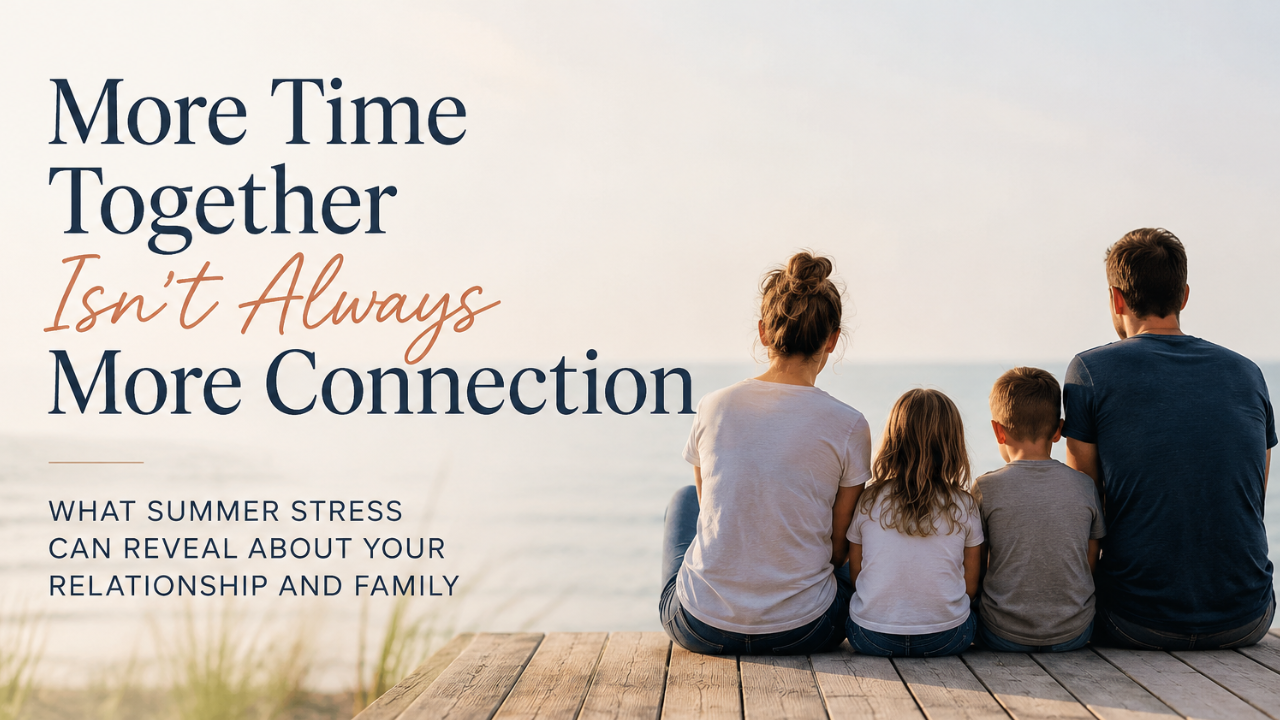
They had been looking forward to the vacation for months.
It was supposed to be a chance to step away from work, school schedules, carpools, deadlines, and the endless responsibilities of daily life. They imagined relaxed mornings, family dinners, and time to reconnect without constantly watching the clock.
Instead, the trip felt tense almost from the beginning.
One parent carried most of the responsibility for packing, planning, and keeping everyone on schedule. The other felt criticized every time something went wrong. The children argued over space, activities, and screen time. Small decisions—where to eat, when to leave, how much money to spend—became unexpectedly emotional.
By the drive home, everyone was exhausted.
No one said, “That was exactly what we needed.”
Instead, the car doors closed a little harder than necessary, and each person went inside carrying more than their luggage.
This experience is more common than many families realize.
Summer is often presented as a season of freedom, closeness, and fun. But for many couples and families, it can also bring disrupted routines, financial pressure, childcare challenges, competing expectations, and more time together without more emotional capacity.
Sometimes summer stress creates new challenges.
More often, it reveals the patterns that were already there.
Why Summer Can Feel So Difficult for Couples and Families
During the school year, routines often provide structure for the entire household.
Parents know when they are working. Children know when they are expected to be at school, activities, or home. Meals, bedtimes, transportation, and responsibilities may not run perfectly, but there is usually a rhythm.
Summer changes that rhythm.
Children may be home while parents are still expected to maintain the same level of productivity at work. Camp schedules change from week to week. Vacations require planning, money, and coordination. Extended family visits can introduce additional expectations. Couples may have less privacy and fewer opportunities to recover after stressful interactions.
Even positive experiences can be demanding.
A family trip may involve hours of preparation, unfamiliar sleeping arrangements, travel delays, overstimulated children, financial decisions, and pressure to make the experience meaningful.
When everyone is tired and out of routine, ordinary frustrations can begin to feel much more significant.
The disagreement may appear to be about who forgot the sunscreen.
But underneath it, someone may be thinking:
Why am I always responsible for remembering everything?
The argument may seem to be about how much time a partner spent checking work email.
But underneath it may be:
Even when we are together, I do not feel important to you.
The conflict may begin with a child refusing to participate in a family activity.
But beneath the parents’ reaction may be fear, disappointment, or disagreement about how the situation should be handled.
The surface issue matters. But it is often not the whole issue.
More Time Together Does Not Automatically Create Emotional Connection
We often assume that closeness is a natural result of proximity.
If we spend more time together, take a vacation, share more meals, or reduce outside obligations, we expect to feel more connected.
But physical togetherness and emotional connection are not the same thing.
Emotional connection develops when people feel noticed, understood, considered, and emotionally safe.
A couple can spend an entire week together and still feel alone.
A family can participate in multiple activities while avoiding the conversations that matter most.
Partners can communicate constantly about schedules, meals, children, errands, and logistics without sharing much about their internal lives.
Over time, a relationship can begin to feel more like a management system than an emotional partnership.
This does not necessarily mean that love has disappeared.
It may mean that practical life has taken up so much space that curiosity, affection, honesty, and emotional responsiveness have been pushed to the side.
Summer may make that distance more visible because there is an expectation that everyone should be enjoying themselves.
When the closeness does not happen, people may feel disappointed or even frightened.
They may wonder:
Why are we not happier now that we finally have time together?
Have we grown apart?
Is this just stress, or is something deeper happening?
Those are important questions. But they are usually better explored with curiosity than with immediate conclusions.
Stress Reveals How We Protect Ourselves
When people feel overwhelmed, disappointed, criticized, or emotionally unsafe, they often fall into familiar protective patterns.
One person may become controlling.
They create plans, monitor details, and become increasingly frustrated when other people do not follow through. Underneath the controlling behavior may be anxiety or a belief that everything will fall apart unless they take charge.
Another person may withdraw.
They become quiet, spend more time on their phone, avoid difficult conversations, or emotionally disappear. Their withdrawal may look uncaring to others, but it may be an attempt to avoid making the conflict worse.
Someone else may become critical.
They point out what is going wrong, focus on what other people are not doing, or express disappointment through sharp comments. Beneath the criticism may be a wish to feel supported, valued, or less alone.
Another family member may become the peacemaker.
They try to manage everyone’s emotions, reduce tension, and prevent arguments. Although this may temporarily calm the situation, it can also keep important concerns from being addressed.
Children have protective patterns too.
A child may act out, become unusually demanding, withdraw, take sides, or try to make everyone laugh when tension rises.
These reactions are not signs that someone is simply “the problem.”
They are often attempts to manage discomfort.
The difficulty is that one person’s protective response can activate another person’s deepest fear.
The more one partner criticizes, the more the other withdraws.
The more one parent takes control, the more the other feels dismissed and disengages.
The more a child acts out, the more divided the parents become about how to respond.
Soon, everyone is reacting to everyone else.
The pattern becomes the problem.
The Argument Beneath the Argument
Recurring relationship conflict is rarely only about the subject being discussed.
Couples may argue repeatedly about money, parenting, household responsibilities, sex, in-laws, work, or time together. Families may become stuck around rules, independence, communication, or loyalty.
But underneath these arguments are often deeper emotional questions:
Can I count on you?
Do my needs matter?
Am I carrying this alone?
Do you respect me?
Is there room for my experience in this family?
Will you still care about me when we disagree?
Am I safe being honest with you?
When these questions remain unspoken, people often communicate them indirectly.
A request becomes criticism.
A fear becomes anger.
A need for reassurance becomes repeated questioning.
A desire for space becomes emotional distance.
A concern about the family becomes an argument about one child’s behavior.
This is why trying to solve only the surface problem may not create lasting change.
A couple may develop a better vacation schedule, but still feel disconnected.
Parents may agree on a rule, but remain resentful about how decisions are made.
A family may stop arguing about one issue, only to have the same emotional pattern appear somewhere else.
Lasting change usually requires understanding what happens underneath the conflict.
Is This a Stressful Season or a Deeper Relationship Problem?
Not every difficult summer is evidence of a serious relationship crisis.
All couples and families experience periods of stress. People become tired. Patience decreases. Communication becomes less thoughtful. A disappointing vacation may simply be a disappointing vacation.
At the same time, stress can reveal concerns that deserve attention.
Consider whether the conflict seems temporary or whether it reflects a long-standing pattern.
You might ask:
-
Do we recover after disagreements, or does resentment continue to build?
-
Can we talk about difficult subjects without becoming cruel, dismissive, or completely shut down?
-
Do both people feel able to express their needs?
-
Are the same conflicts repeating without resolution?
-
Does one person feel responsible for holding the relationship or family together?
-
Are the children becoming involved in adult tension?
-
Has emotional or physical closeness significantly decreased?
-
Are one or both partners questioning whether they want to remain in the relationship?
-
Does the current way of relating feel unsustainable?
The purpose of these questions is not to label the relationship as healthy or unhealthy.
They are meant to help you notice where you are.
Awareness does not solve everything, but it creates the possibility of making a more thoughtful choice.
When Couples Want to Strengthen the Relationship
Some couples know that they want to remain together.
They may still love one another deeply, but feel caught in a conflict cycle they cannot interrupt on their own.
They may say:
“We keep having the same argument.”
“We do not know how to talk without becoming defensive.”
“We are functioning as parents, but we no longer feel like partners.”
“We want to reconnect, but we do not know where to begin.”
Couples therapy can help partners slow down the pattern and understand what is happening for each person beneath the reaction.
The goal is not to determine who is right.
The goal is to recognize the cycle that has developed between them and create new ways of responding.
Strengthening a relationship may involve learning to express needs more directly, listening without immediately defending, repairing after conflict, rebuilding trust, and creating small moments of emotional connection.
Relationships are rarely transformed by one dramatic conversation.
Healing more often happens through repeated moments in which people begin to experience one another differently.
One partner stays emotionally present instead of withdrawing.
Another expresses hurt without attacking.
Someone acknowledges the impact of their behavior without immediately explaining it away.
A difficult conversation ends with greater understanding instead of greater distance.
These moments may seem small, but they can gradually change the emotional climate of a relationship.
When One or Both Partners Feel Uncertain
Not every couple enters counseling with the same goal.
Sometimes one partner wants to repair the relationship while the other is unsure whether they want to stay.
Traditional couples therapy may not be the right first step in that situation because the couple has not yet agreed that they are working toward restoration.
Discernment counseling is designed for couples who are uncertain about the future of their relationship.
It creates space to understand what has happened, what each person has contributed to the dynamic, and what paths may be available.
The purpose is not to pressure someone to remain married or partnered.
It is also not to move the couple quickly toward separation.
The purpose is clarity.
A couple may decide to make a committed effort to restore the relationship. They may decide to move toward separation or divorce. Or they may recognize that they need more time and information before making a major decision.
When a relationship feels uncertain, clarity is often more helpful than pressure.
People tend to make better decisions when they understand not only what their partner has done, but also their own patterns, fears, needs, and responsibilities.
When Separation or Divorce Becomes the Path Forward
Sometimes a couple decides that the relationship will end.
That decision can bring grief, anger, fear, relief, guilt, or a complicated combination of emotions.
Even when separation is necessary, the way a couple moves through it matters.
Divorce does not end every relationship between two people, particularly when they share children, extended family connections, financial responsibilities, property, or a community.
Couples mediation can help people make decisions with greater clarity and less unnecessary conflict.
The goal is not to pretend that the ending is painless.
It is to reduce avoidable harm.
A more thoughtful process can help couples communicate about parenting, finances, schedules, responsibilities, and future boundaries without turning every decision into another emotional battle.
When children are involved, this becomes especially important.
Children do not need parents who agree about everything.
They do need adults who work to protect them from being placed in the middle.
They need permission to love both parents.
They need reassurance that adult decisions are not their responsibility.
They need stability, honesty appropriate to their age, and as much freedom as possible from loyalty conflicts.
A respectful separation does not erase grief, but it can create a healthier foundation for the family relationships that continue.
When the Entire Family Is Affected
Sometimes the tension is no longer contained within the couple.
It begins to shape the whole household.
Children may become more reactive, withdrawn, anxious, or oppositional. Siblings may fight more often. Parents may become divided over discipline or boundaries. One child may be identified as the source of the family’s problems, even though their behavior is connected to a larger pattern.
Family therapy looks beyond one person’s behavior and considers the relationships surrounding it.
This does not mean that every family member is equally responsible for every problem.
It means that families are interconnected.
When one relationship changes, the rest of the family often responds.
Family therapy can help parents and children understand how stress is affecting each person, communicate more openly, establish healthier boundaries, and reduce patterns of blame.
Family mediation may also be helpful when families need support navigating specific disagreements, transitions, parenting decisions, elder-care concerns, or ongoing conflict.
The goal is not to create a family that never disagrees.
It is to help people disagree without losing respect, emotional safety, or the ability to move forward.
A Summer Relationship and Family Check-In
Before the season ends, consider taking a quiet moment to reflect.
Try not to use these questions to build a case against someone else.
Use them to become more curious about the pattern and your place within it.
What happens to me when I feel overwhelmed?
Do you become critical, quiet, controlling, defensive, or overly accommodating?
What are you trying to protect yourself from in that moment?
What keeps repeating between us?
Look beyond the subject of the latest argument.
What is the familiar sequence?
Who pursues? Who withdraws? Who becomes louder? Who gives in? Who tries to keep the peace?
What need am I expressing indirectly?
Are you asking for appreciation through criticism?
Are you asking for space by shutting someone out?
Are you asking for reassurance through anger?
What might happen if you named the need more clearly?
What might the other person be experiencing?
Understanding someone’s experience does not mean agreeing with every action.
It means making room for the possibility that there is more happening beneath their behavior.
Are the children being pulled into adult tension?
Are they carrying messages, taking sides, monitoring adults’ emotions, or feeling responsible for keeping the family stable?
What is one small interaction we could change?
You do not have to repair the entire relationship today.
What would it look like to listen for two more minutes?
To apologize without adding a defense?
To ask a genuine question?
To offer appreciation?
To pause before reacting?
Small moments can become the beginning of a different pattern.
You Do Not Need to Know the Entire Path
Many people postpone seeking support because they believe they should already know what they want.
They think they need to be certain that they want to repair the relationship.
Or certain that they want to leave.
Or certain about what is causing the family’s difficulties.
But certainty is not always the starting point.
Sometimes the most honest place to begin is:
We cannot keep relating to one another this way.
You may want to strengthen your relationship.
You may need help deciding whether there is a path forward.
You may be moving through separation or divorce and want to reduce conflict.
You may see that the entire family is being affected and need a place where everyone can be heard.
Couples Therapy & Mediation and Family Therapy & Mediation can provide different forms of support depending on where your relationship or family is today.
A stressful summer does not tell the whole story of your relationship.
A difficult vacation does not mean your family is broken.
But these experiences may reveal patterns that are asking for your attention.
And once a pattern can be seen, it becomes possible to respond with greater awareness, compassion, and choice.
To learn more about Couples Therapy & Mediation or Family Therapy & Mediation, visit Solutions Therapy & Mediation to explore which form of support may fit your current situation.
This article is intended for general educational purposes and is not a substitute for individualized mental health, legal, or medical care.

Stay connected with news and updates!
Disclaimer
The views, opinions, and content expressed and produced by our guests do not necessarily reflect the views, opinions, or policies of Relationship Solutions Programs or Susan Regan. If you have any questions, concerns, or feedback regarding content, please contact Susan Regan.